In my conversations with clients and people from across the research industry, I am often asked: “Why pay for professional translation when an LLM can translate instantly?”
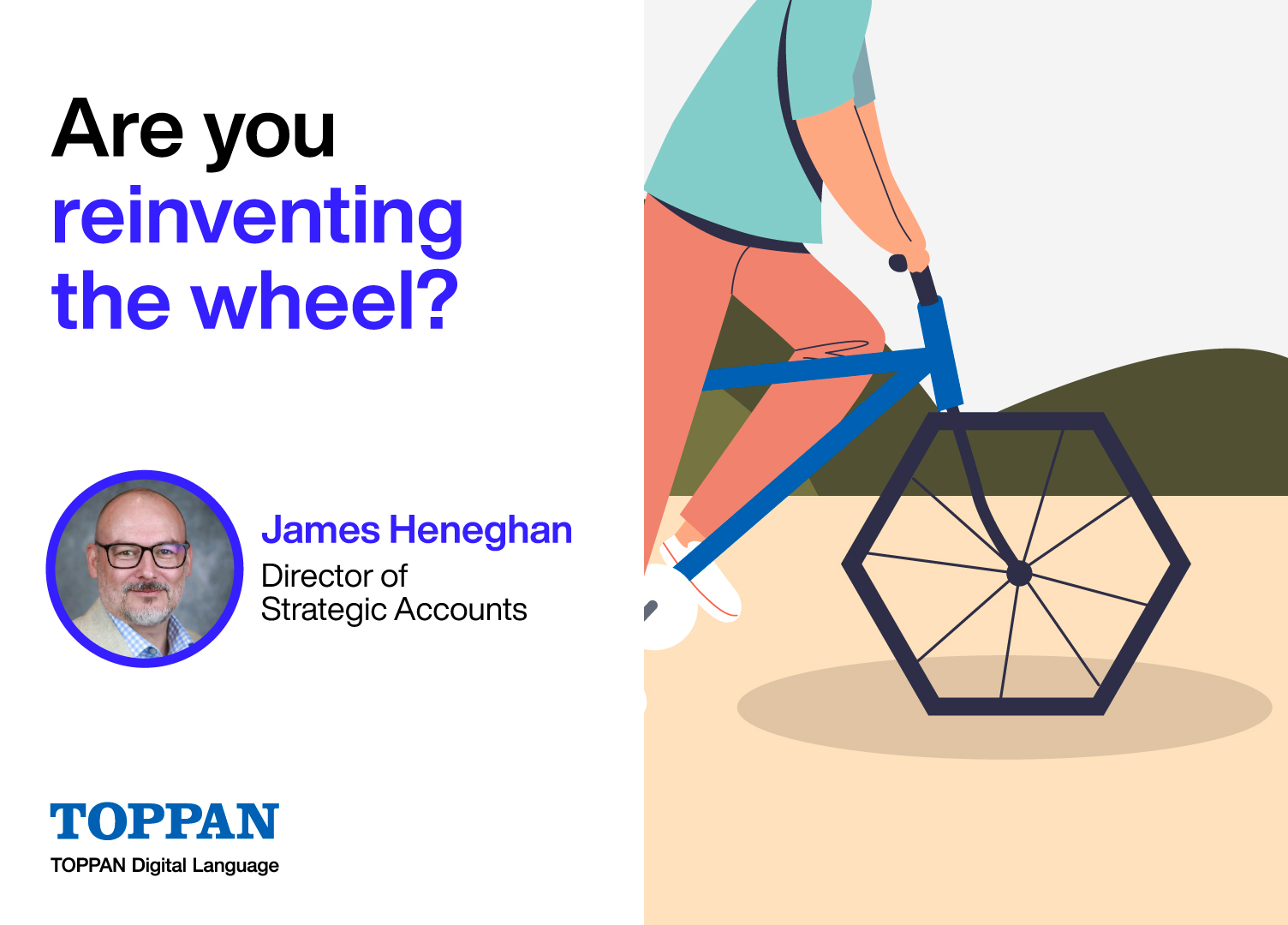
For simple text, large language models are impressive. But when it comes to market research survey translation, relying on an LLM alone is like reinventing the wheel, except the wheel you build turns out to be hexagon shaped. It technically rolls, but not very well.
At its core, survey translation is about preserving research integrity across markets, not just translating one language to another. A poorly translated questionnaire doesn’t just sound awkward, it introduces bias, changes meaning and undermines the comparability of data across countries.
This is where the Language Services Provider (LSP) model still has a decisive advantage.
Professional translation workflows are complex, they combine numerous tech elements such as Machine Translation integrated with CAT (Computer-Assisted Translation) tools, linguistic assets such as Translation Memories (TMs) and glossaries, automated QA checks, and (critically) human linguists in the loop.
Each component exists for a reason.
CAT tools and TMS platforms ensure that terminology, phrasing and response scales remain consistent across waves of research. If a survey question or brand attribute is translated one way in a previous study, it will appear the same way again. That consistency is vital for longitudinal tracking and brand studies.
Glossaries and translation memories act as institutional knowledge repositories. They capture approved wording, industry terminology and cultural nuances built up over years of research. An isolated LLM session has no persistent understanding of those assets unless they are carefully engineered into a broader system. In short, LLMs have no means of managing the critical element of consistency.
Automated QA tools provide another layer of reliability. They catch issues such as missing variables, inconsistent scales, placeholder errors or mistranslated response options, the kinds of problems that can easily slip through purely generative translation.
And then there are the human linguists.
Market research questionnaires contain subtle intent: tone calibration, culturally appropriate phrasing and respondent comprehension levels. Human linguists understand when a literal translation will distort meaning or introduce unintended bias. They adapt the wording while preserving the research objective.
An LLM, working alone, simply generates the statistically most likely sentence.
Sometimes that’s good enough, sometimes it isn’t. When collecting thousands of responses across markets, those small inaccuracies compound quickly.
The irony is that the most advanced translation workflows already use AI.
At TDL, we use Managed AI to deliver AI-powered translations through managed, risk‑controlled environments that combine technology, linguistic assets, and human oversight. Furthermore, LSPs have integrated machine translation for years, all within controlled and risk-managed environments.
In other words, the wheel has already been engineered.
Trying to replace that ecosystem with a single LLM prompt is not innovation. All it achieves is a rebuild of a solved system with fewer safeguards.
Yes, LLMs are powerful tools. But in professional localization, especially for something as sensitive as cross-market research measurement, intelligent orchestration is essential. LLMs work best as one single component in a proven well-orchestrated workflow, not as a standalone replacement.
Otherwise, unforeseen risks occur when launching global research on a wheel that looks round at first glance… but turns out to have six sides.
The wheel has already been engineered. The smartest move is knowing when not to rebuild it.